
What I've come to realize during my Alife research is that there is a direct correlation between the existence of the "organism" and the substrate upon which it exists. The environment provides the required conditions for the organism to exist and effectively drives its existence. In turn, the goal of the organism is to maintain a kind of homeostasis and keep itself balanced in order to exist in that environment.
The first simulator I built is based on Christopher Langton's vant (virtual ant). It's a simple setup where vants do not possess any memory whatsoever, and react to the state of the tiles in the environment. When a vant lands on a white tile, it flips it to black, and turns 90-degrees to the right. When it lands on a flipped black tile, it switches it back to white, and turns 90-degrees to the left. This is the RL rule (right-left).
The interesting thing is that after about 10,000 cycles, the vants start generating a predictable, repetitive loop cycle of 104 steps that goes to infinitely.
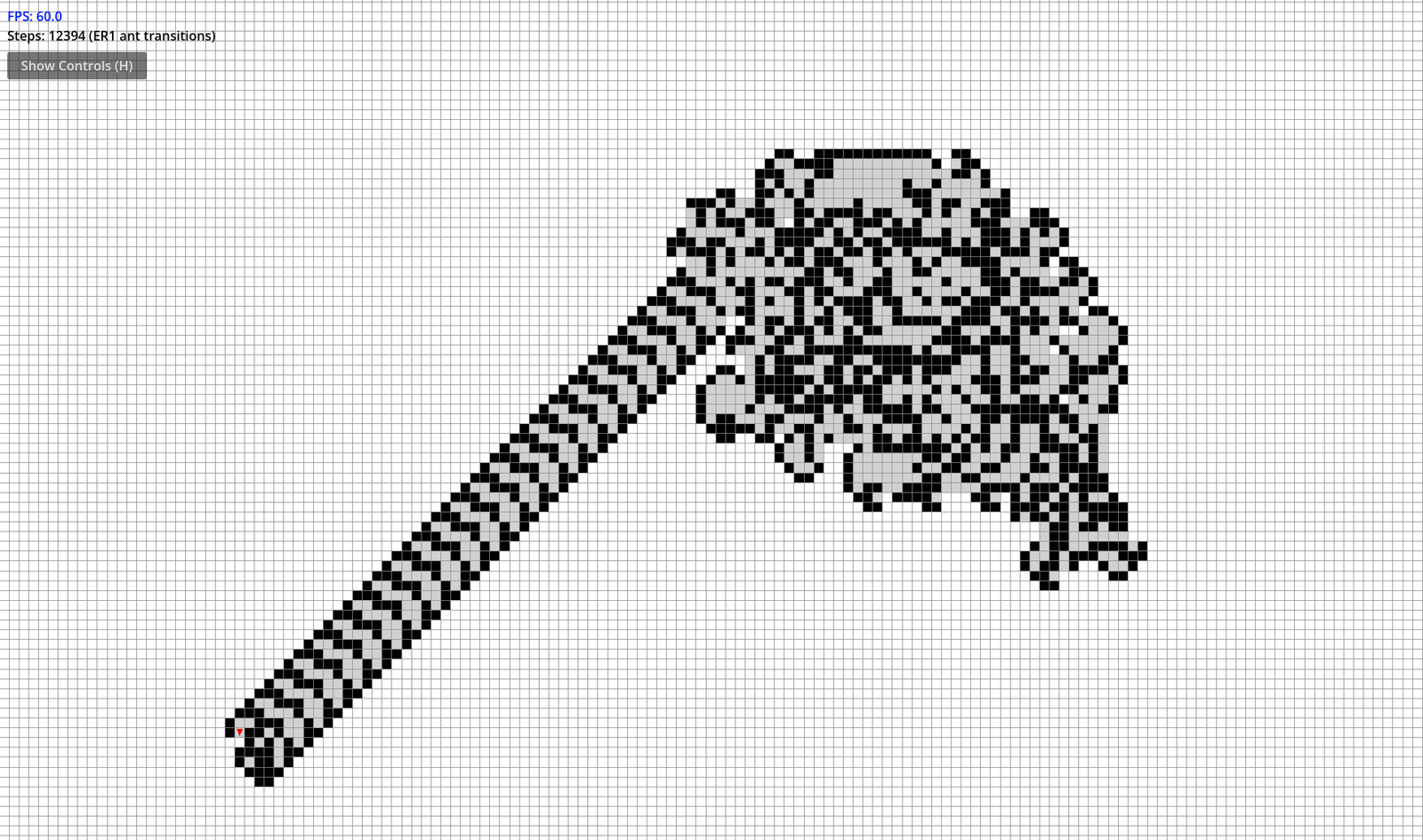
The rest of the simulator works on variations of Langton's Ant, and introduces additional experimental rules (ER) to it. ER1 represents Langton's control ant. ER2 introduces Greg Turk's vant rules using RRLL rules.
In this version, I added additional functionality including temporal control of the tile lifespan, and trace behavior on the tiles by ants that already visited them. In ER6, the user has the option to create their own RL rule settings,
The next simulator I'm developing adds local memory to my artificial life entities (ALEs) and they can now interact with the environment and sense the data that is produced by it.
This changes the dynamic since now there is a record of information that will allow the ALEs to build a type of history and establish a direct link with the substrate. The data provided in the environment (the symbols) have no preassigned symbolic meanings or externally defined performance objectives.
Beyond the technical implementations of the simulator, this also raises philosophical questions about how we can examine life. The biases we have are based on what we know and understand of living things i.e. the need to survive, to pass on genes to future generations, to reproduce and evolve. But do truly artificial "living" systems require these constraints? In some ways, applying these rules limits what Langton said about "life as it could be".
Organic, biological life requires first and foremost an awareness of self, the environment, and the directive to not expire. Survival is the driver. Artificial life does not have that constraint, unless it is coded into it. If these limitations are removed, then what can we learn from it?